Overview
In 1869, Sado Mine was acquired by the national government, and engineers from overseas were brought in to introduce Western mining technology. Under the direction of Oshima Takato (1826–1901), a leading figure in Japan’s mining industry, the mine underwent development and expansion, including the construction of a new mineral processing plant and Oma Port.
Ownership of Sado Mine was transferred to the Imperial Family in 1889. At which time, Watanabe Wataru (1857–1919), head of the Sado Branch Office of the Imperial Property Bureau, established a mining school to train new engineers.
The mine was privatized in 1896 when it was sold to Mitsubishi & Co., Ltd. Increased demand for gold in the 1930s saw additional expansions, such as the Takato Crush Plant and Kitazawa Flotation Facility.
Most of these facilities were closed in 1953, when production was curtailed to extend the mine’s lifespan. Mining continued on a reduced scale until 1989, when Sado Mine officially ceased operation.

The Takato area includes the Takato Shaft and Doyu Tunnel, which opened in 1889 and 1899, respectively. It was a major hub for Sado Mine, with various mining, ore processing, and power generating facilities. The Takato Crush Plant and Takato Ore Storage House have been preserved, and the mine’s original machinery is on display in the Sado Mine Car House (Machine Shop).
The Takato Crush Plant mechanically sorted and crushed ore, which was then transported to the storage house via a conveyor belt system. The Takato Ore Storage House was used as temporary storage and had a capacity of 2,500 tons. Both facilities opened in the late 1930s and remained in operation until Sado Mine closed in 1989.

Among the various areas of Sado Mine, the Kitazawa area experienced the most dramatic changes following the mine’s nationalization in 1869. In the late nineteenth century, Kitazawa became a center for processing and smelting ore. Its facilities were constantly upgraded with the latest advances in technology.
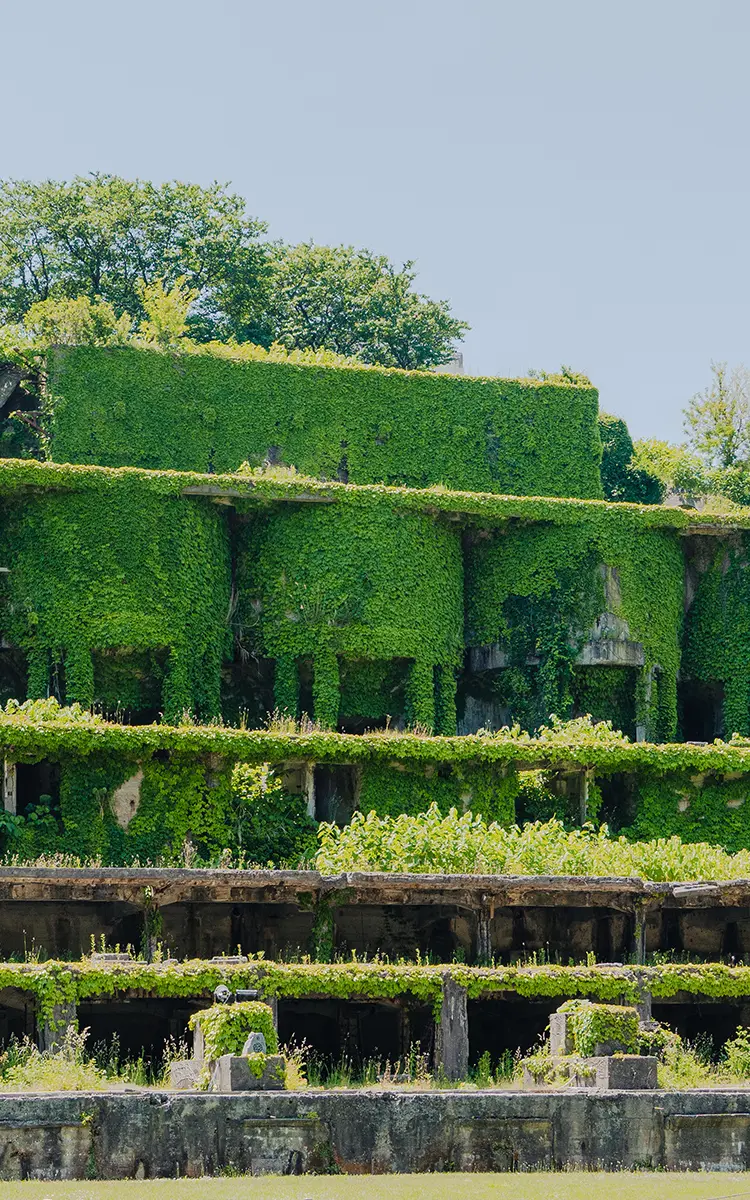
Several structures from this period remain, including the Kitazawa Cyanidation and Flotation Plant, built in the late 1800s; the Kitazawa Thermal Power Plant Generator Building, built in 1908; the Kitazawa Flotation Plant, built in the 1930s and early 1940s; and the Thickener, completed in 1940[JL2.1]. The Sado Branch Office of the former Imperial Property Bureau has been converted into the Aikawa Local History Museum and displays various mine-related artifacts.
The Kitazawa Flotation Facility was built in 1937 and could process up to 50,000 tons of ore per month. Using the flotation method, which was cutting-edge technology at the time, the facility produced the highest annual gold output in the mine’s history. [JM3.1]The building’s exterior has been removed, leaving just the skeleton of the original facility.

The Oma area once had a thermal power plant and a seaport. The seaport, called Oma Port, was exclusively used by Sado Mine to ship precious metals such as gold and silver, as well as bring in mining equipment.
Government attempts to reclaim land for Oma Port ended in failure due to turbulent seas. In response, the government brought on Hattori Choshichi (1840–1919) as project leader. Hattori had helped construct seawalls and embankments in Aichi Prefecture and was known for developing the “artificial stone method,” a technique that combines stone masonry with mortar made from slaked lime, soil, and water. Under Hattori’s direction, Oma Port began construction in 1890 and was completed in 1892. The cranes, loader bridge, thermal power plant, and other port facilities were added over time.
Today, the artificial-stone seawalls, crane bases, and other vestiges provide a glimpse of what the port looked like at the time of its construction.

令和7年度 文化資源活用事業費補助金(文化財多言語解説整備事業)



 お問い合わせ